|
May 15, 2000
Work
History
*I
was on active duty with the United States Air Force from May 1963
through May 1967.
During
that time I was trained and served as a “Defense Guided Missile
Technician”,
with
a “Secret” security clearance, at the 37th Air Defense
Missile Squadron located
at
Kincheloe AFB, Michigan. I was honorably discharged on May 16, 1967
*I
have been an employee of the National Radio Astronomy Observatory (NRAO)
since
May 29, 1967. To date I’ve worked in several locations for the NRAO
and
held
a variety of positions and titles.
*From 1967 through June of 1975 I held the position of Telescope
Operator at the
Green Bank, West Virginia facility of NRAO rising to the grade of
Technical Specialist
II.During that period I performed my duties on two major radio telescope
systems,
the
Green Bank Interferometer and the 300-ft. Radio Telescope.
*In June of 1975 I was transferred to Socorro, New Mexico at the
beginning of the
construction of the Very Large Array (VLA) Radio Telescope. From 1975
through 1987,
I was a member of the Operations Division and held the positions of
Array OPERATOR
Maintenance Coordinator and Safety Officer. During that period I helped
design the
on line operating system and also designed the array operators console.
I was
responsible for the development of the Maintenance Management software
system,
on line weather station, wye communications (antenna telephone) system
and the
site
VHF radio system.
*As the VLA transitioned from construction to operation, I
authored numerous
operations
rules and procedures that led to my appointment as Safety Officer, in
1983,
for the VLA Site. As Safety Officer, I completed the “Basic Safety
Management”
series of courses given by the Safety Training Institute of the National
Safety
Council.
*During 1982-83 I helped to plan the VLA Visitor Center having the
specific
responsibility
of leading a team that designed the “Walking Tour.” From 1987-89
I
participated in the refurbishment of the visitor center and coordinated
the public
relations
effort on behalf of NRAO for its part in the Voyager/Neptune encounter.
This
included arranging for a large screen TV display for the general public
in
New
Mexico Tech’s Macey Center.
*In 1987 I accepted a position in the NRAO Computing Division
where I supervised
the Computer Operators while maintaining my position of Safety Officer.
In 1989
our group was moved into the newly completed Array Operations Center
(AOC)
on the campus of New Mexico Institute of Mining and Technology. My
safety duties
were expanded to include the Very Long Baseline Array (VLBA) Radio
Telescope,
which was under construction at that time.
*Between 1989 and 1997, I assumed the additional duties of
supervising the VLA
archive project, which has successfully copied and reformatted 1.5
terabytes of
recorded raw VLA data, dating back to June of 1976. I also helped to
develop the
NRAO on line reservation system for visiting scientists and did all
scheduling of
data processing resources for staff and visiting scientists.
*In October of 1997, I was promoted to full time Safety Officer
for NRAO-New
Mexico with responsibility for all aspects of safety at the VLA, VLBA,
AOC and
the new Atacama Large Millimeter Array (ALMA) project.
*As a Safety Professional with expertise in the field of
observatories, I have
completed
a number of consulting safety audits for the Kitt Peak National
Observatory
in Tucson, Arizona, the National Solar Observatory at Sunspot,
New
Mexico and the Apache Point Observatory also at Sunspot, New Mexico.
*Beginning in 1990, I began a relationship with the New Mexico
Tech Astronomy
Club
that led to the design and construction of the Frank T. Etscorn Campus
Observatory.
Beginning with my initial design of the roll off roof observatory
building,
I supervised its construction as well as the design and construction of
subsequent
structures at the observatory. Currently I am involved with an upgrade
of
the facility that will allow one of the telescope systems to become
fully robotic
and useable
through the Internet.
*On July 1, 1999, I was given a one-year, renewable appointment as
an Adjunct
Research
Scientist in the Research and Economic Development Division of the
New
Mexico Institute of Mining and Technology.
*In April of 2000 I started a safety consulting business known as
“Stellar Safety
Services” (Home page: http://www.sdc.org/~kc5ntw/
).
Community
Service
Member of the Pocahontas County Memorial
Hospital Board of Directors in West
Virginia,
1974-75.
Member
and Past Chair of the San Miguel School Advisory Board, Socorro, NM
1982-88.
Elected
member and Vice President of the Socorro Consolidated Schools, Board
of
Education, 1989-93.
Professional
Affiliations
Member and Chair-Elect of the Research,
Development & Emerging Technologies
Section
of the Business and Industry Division of the National Safety Council.
Member
of the Rio Grande Chapter of the Society of Fire Protection Engineers,
1985-91.
Hobbies
and Other Activities
Founder, Past President and member of the
Socorro Train Gang model railroad club.
Member
of the Socorro County Historical Society.
Member
of The Albuquerque Astronomical Society.
Member
of the New Mexico Tech Astronomy Club.
Licensed
Amateur Radio Operator (Ham) and member of the Socorro Amateur
Radio
Association since April 1995. Call sign KC5NTW.
Vice
President and Safety Officer of the New Mexico Steam Locomotive and
Railroad
Historical Society and involved with the restoration to operation of the
former
Santa Fe Railroad steam locomotive #2926.
Co-founder of "Enchanted Skies Star
Party"
Http://www.socorro-nm.com/starparty.html
A national star party for
amateur astronomers.
Honors
In 1997 I was honored as the Socorro County
Chamber of Commerce’s
“Man
of the Year.”
A second honor came in 1998 when I was
nominated and inducted into Sigma Pi
Sigma,
a national physics honorary society of the Society of Physics Students.
On May 13, 2000 I was awarded an honorary
degree, “Master of Science in
Astronomical
Instrumentation,” by the New Mexico Institute of Mining and
Technology.
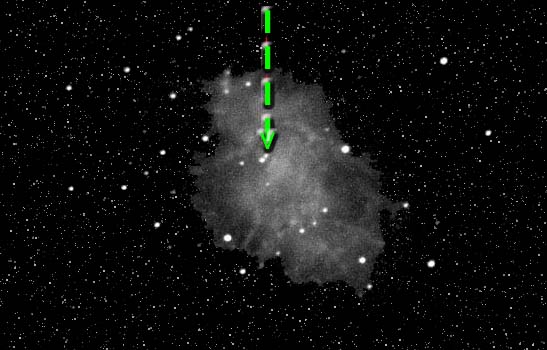
(The background image shown here is a giant
supernova remanent located in the
constellation of Taurus, the Bull. The
object is known as M1, a.k.a. The Crab Nebula and
is the debris from an exploded star.
The faint star at the bottom tip of the arrow below
is the famous Crab Pulsar, the remains of
the exploded star that created the nebula.
This image was recorded by Dr. Dan
Klinglesmith using a Celestron C-14 telescope
equipped with SBIG ST-8 CCD camera at the
Etscorn Campus Observatory at the New
Mexico Institute of Mining &
Technology.)
Return to Main Page
|